194 पटक हेरिएको
  Karnali: In Karnali, issues related to total sanitation, dignified menstrual hygiene management, and Gender Equality, Disability and Social Inclusion (GEDSI) have been brought into wider discussion through digital platforms.
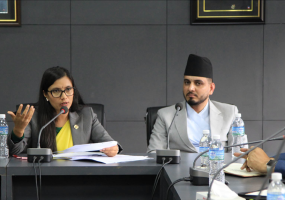
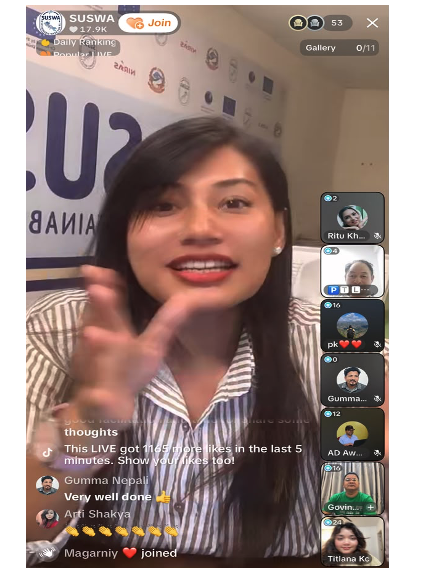
Around 130 participants shared their experiences, perspectives, and messages on various aspects of sanitation during the programme, “Conversations on Sanitation: A Debate on Total Sanitation in Nepal,” organized by the Sustainable Water and Sanitation for All (SUSWA) Project.
The programme brought together WASH sector experts and stakeholders, government representatives, media professionals, content creators, artists, and community representatives. It was livestreamed through the SUSWA Project’s TikTok platform.
The event also announced and recognized the winners of the Total Sanitation Video Challenge. The SUSWA Project had organized the challenge to promote total sanitation messages through TikTok videos, Facebook Reels, posts, and other creative content.
Beyond Toilet Construction: Focus on Total Sanitation
Opening the technical discussion, Govinda Raj Rokaya, Sanitation and Hygiene Specialist at the SUSWA Project, said that total sanitation is not limited to access to toilets alone. He emphasized that sustainable sanitation and hygiene practices, community ownership, quality services, and effective leadership by local governments are key foundations of total sanitation.
He shared that in Karnali, efforts are now moving beyond achievements in toilet construction and access toward ensuring sustained behaviour change and integrating sanitation into the daily lifestyles of communities.
Raju Tirwa, GEDSI Specialist at the SUSWA Project, emphasized that sanitation must be accessible, inclusive, and dignified for everyone. He said that GEDSI should be effectively integrated into total sanitation programmes to ensure that individuals and communities facing different barriers to accessing services are not excluded from sanitation services.
Dignified menstrual hygiene management was also given priority during the programme. Discussions focused on the need to create an environment in which women and adolescent girls can manage menstruation safely, hygienically, and with dignity.
Singer Bipana Singh shared her experiences and perspectives on changing practices related to menstruation and sanitation, along with a sanitation-themed musical performance.
Social Media as an Effective Platform for WASH Messages
The programme also discussed the role social media can play in delivering WASH-related messages to communities. Content creator and government employee Srijana Baduwal shared her experience of using social media to present WASH issues in simple, engaging, and easily understandable ways.
Similarly, Pushpa KC, a WASH Facilitator from Darma Rural Municipality in Salyan, emphasized that the sustainability of total sanitation requires active community participation, collective efforts, and the development of leadership at the local level.
Through the Video Challenge, the SUSWA Project said it aimed to encourage members of the public to become storytellers and advocates for sanitation. The programme demonstrated that short videos, songs, community experiences, and other creative content can help take sanitation messages beyond traditional communication channels and reach wider audiences and communities.
Speaking at the programme, P.T. Lopchan, Editor of WASH Khabar, said that the water, sanitation, and hygiene sector has an important role to play in building a healthy, developed, and prosperous Karnali. He appreciated the work being carried out by the SUSWA Project to promote total sanitation among communities in the province.
He further noted that documenting and widely disseminating positive practices, lessons learned, and achievements taking place at the local level through communication can inspire other communities to adopt successful sanitation practices.
Recognition for Digital Sanitation Champions
The programme announced 10 winners of the Total Sanitation Video Challenge. The winners were @kabitaoli75, @saritarawal1235, @prabeshikaolipun, @purna.prd.hamal, @ishwarikumaridang1, @sushilapariyar931, Gyalpo Donton, Bimala Kumari Rokaya, Chandyodaya School, and Darma Khaltakuri Basthana.
The SUSWA Project stated that the winners would be presented with attractive gift items.
The creative content produced by the winners demonstrated that social media is not limited to entertainment. It can also serve as an effective platform for raising awareness, sharing knowledge, mobilizing communities, and promoting positive behaviour change.
By bringing together technical knowledge, community experiences, creative presentations, and digital communication on a single platform, the programme conveyed the message that total sanitation is not the responsibility of the WASH sector alone. Participants emphasized that sustainable total sanitation requires shared ownership and active engagement from communities, local governments, media, civil society, and citizens.
The programme concluded with a musical performance by singer Bipana Singh and a shared commitment to building a more inclusive, dignified, and sustainable sanitation movement in Karnali.
The programme was facilitated by Bina Bista, Sanitation Marketing and Sales Officer at the SUSWA Project.