416 पटक हेरिएको
HETAUDA : Within just five dhur (about two and a half aana) of land, houses, toilets, bathrooms, and water taps all stand together in the same small space. This is not the story of a single household — around 1,900 families in the settlement live in similar conditions.
According to sanitation standards, toilets must be constructed at least 50 feet (15 meters) away from a water source. But in Simaltar, limited land availability has forced many families to build toilets and hand pumps almost touching each other.
The area in question lies in Ward No. 11 of Hetauda Sub-Metropolitan City. When asked how such dense and unplanned construction occurred, Josan Singh Yonjan, a member of the Simaltar Tole Development Committee, explained, “This is not a settlement developed through urban planning. It’s built on government land. People started settling here before any urban plans were made around 1995 or 1996 (2052/053 B.S.). The first settlers built houses however they could, and those who came later followed the same pattern, occupying small pieces of land.”

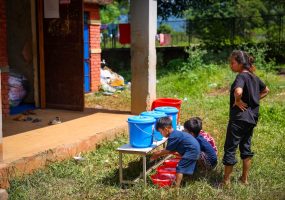
With houses, toilets, and hand pumps squeezed into small plots, the overall water and sanitation condition in Simaltar has become chaotic. “If proper town planning had existed, a water supply agency would have provided safe drinking water and we would have paid for it,” Josan said. “But since that didn’t happen, we’ve been using hand-dug wells and hand pumps as our only accessible source of drinking water.”
Because toilets and water sources stand side by side, residents have been forced to drink contaminated water, said Sharda Sharma, another member of the committee. “The level of underground water pollution is so high that even the water we drink smells like drain water,” she added.

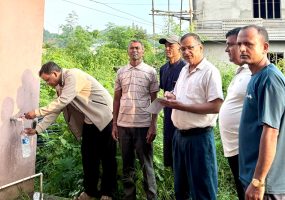
The water from hand pumps has never been tested or purified, which could mean it is contaminated, Yonjan further explained. “The septic tank and hand pump are built almost at the same spot how could the water not be polluted?” he said. “I fear this might lead to health problems in the future.”
In most houses, the so-called septic tanks are merely pits lined with concrete rings, without a solid base. “These pits haven’t filled up for years, meaning the waste could be seeping into the groundwater,” Sharda estimated. “Every year people fall sick with diarrhea. It must be because we’re drinking water mixed with fecal matter. Sometimes we even fear that diseases like typhoid or cholera could spread.”
While the Hetauda Water Supply Management Board oversees the city’s water system, Simaltar residents remain outside the network. Yonjan urged that every household in Simaltar should get a piped water connection to protect public health. “Some families here are poor, while others are better off but safe drinking water should be made affordable and accessible to everyone,” he said.

No awareness or educational programs have been conducted in Simaltar regarding sanitation. “People don’t know what type of septic tank should be built or how far the toilet should be from the hand pump,” Yonjan said. “Without awareness, people can’t protect their own health. We need awareness programs, but none have been organized so far, which is why we’re facing this situation.”
Solid waste is collected twice a month by municipal trucks, which also handle emptying toilet pits when requested, according to Sharma.
Experts argue that Hetauda Sub-Metropolitan City should immediately test the water quality in Simaltar and upgrade septic tanks to standard models. “Even a good initiative, if delayed, becomes useless like decorating after the wedding is over,” a local sanitation advocate said. The municipality must send a technical team to assess the condition and launch urgent programs on safe drinking water and sanitation improvement.
Sanitation experts further warn that only through the adoption of a citywide inclusive sanitation approach can safe sanitation services reach all citizens. The longer the municipality delays taking action, the greater the public health risk will become.