484 पटक हेरिएको
“The source of water is good, but it is unorganized. Due to the open space, outsiders and livestock can enter at any time. People passing by might relieve themselves at the source, and buffaloes might even rest there,” said Chandraman Shrestha, the president of Khudikhola Drinking Water and Sanitation Consumers’ Committee. After hearing this, we decided to inspect the water source.

When we reached the water source, which is about 2 kilometres away from the Khudikhola settlement, the situation seemed even worse than what President Shrestha had described. Except during the season when maize, millet, and other crops are planted, the water source was located in a pastureland. As soon as we arrived at the source, a herd of goats descended from the hill, and some of the goats drank from the water source before climbing back up the hill.

The water that had emerged at the top corner of the field was collected using a concrete structure, but the structure was not effective in containing the water, causing most of it to spill and be wasted. One of the members of the Khudikhola Drinking Water Committee, who was with us on the visit to the water source, attempted to stop the water from flowing by using a sack.
Since external objects can enter the water source and cause contamination, it should not be left open. The water source area should be enclosed with a fence on all sides, allowing only those related to the water supply to enter. However, despite realizing the need for such a structure, the Khudikhola Drinking Water and Sanitation Consumers’ Committee President, Chandraman Shrestha, mentioned that they have been struggling to gather and distribute water due to lack of support.

“Our efforts alone were not enough. We sought help from various organizations for the protection of the water source, but no one paid attention,” said President Shrestha. According to him, this water source was initially used to supply water to the Gagangauda settlement. However, since water started being supplied to Gagangauda from another source, the residents of Khudikhola purchased 2 aana of land in that same water source area.
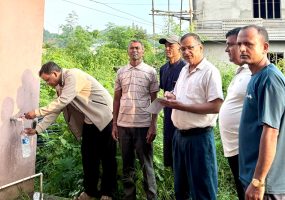
Next, we visited the distribution tanks built in front of Shri Sita Basic School, located near the Khudikhola settlement. Both of the distribution tanks were in a dilapidated condition. Both tanks were cracked, leaking drinking water, and the area was accessible to outside animals and school children. Showing the water supply structures, Raju Pariyar, the secretary of the Aradhana Tole Development Organization, explained that the water was being distributed directly from the source without treatment. He emphasized that the water should be tested and treated before being distributed.
“You have seen the open water source. What is the quality of the water brought from there? It has not been tested so far. The water is being distributed in its natural form. We have requested a filtration tank to purify the water, but so far, no one has understood the needs of the Khudikhola residents.”

The distribution pipelines from the distribution tank to the settlement were also seen to be open in some places and leaking in others.
A road runs through the middle of Khudikhola’s Aradhana Tole. On the right side of the road, as one heads towards Shri Sita Basic School from the settlement, a drain has been constructed. The water distribution line runs through the middle, with pipes extending to homes. However, the distribution pipe is left in the drain, where there is a strong possibility that wastewater from the drain will enter the drinking water pipe and flow all the way to the taps.

Despite being aware of all these issues, Khudikhola residents accuse that no one has paid attention due to the disorganized nature of the settlement. “We have done as much as we can on our own, but we need helping hands. Now, we want to make the drinking water system well-managed,” said Bhupendra Rana Maski, the president of Aradhana Tole Development Organization.
Khudikhola Drinking Water and Sanitation Consumers’ Committee has been providing 24-hour drinking water service to 263 households. The consumer committee collects a water fee of 10 rupees per unit, with one tap connection per household. The settlement of Khudikhola was established in 2056 B.S. by people who were displaced from various districts during the Maoist insurgency.
The origin of Khudikhola is Begnas and Rupa Lake. After the settlement was established, the residents initially relied on Khudikhola’s water for their livelihood. However, due to contaminated water, the settlement was plagued by diarrheal diseases. In search of a safer water source, they eventually discovered the current spring, as explained by Chairman Shrestha.
If the current spring is properly managed by constructing an intake and surrounding it with a fence, the quantity of drinking water would increase, and pollution would be eliminated as well. Ensuring that clean and safe water is supplied directly from the spring would mean that no additional infrastructure for water treatment would be necessary.
Instead, there is a need to construct distribution tanks and a reservoir tank to ensure proportional water distribution to every household. If this is done, the residents of Khudikhola will no longer have to knock on anyone’s door for drinking water in the coming years.