236 पटक हेरिएको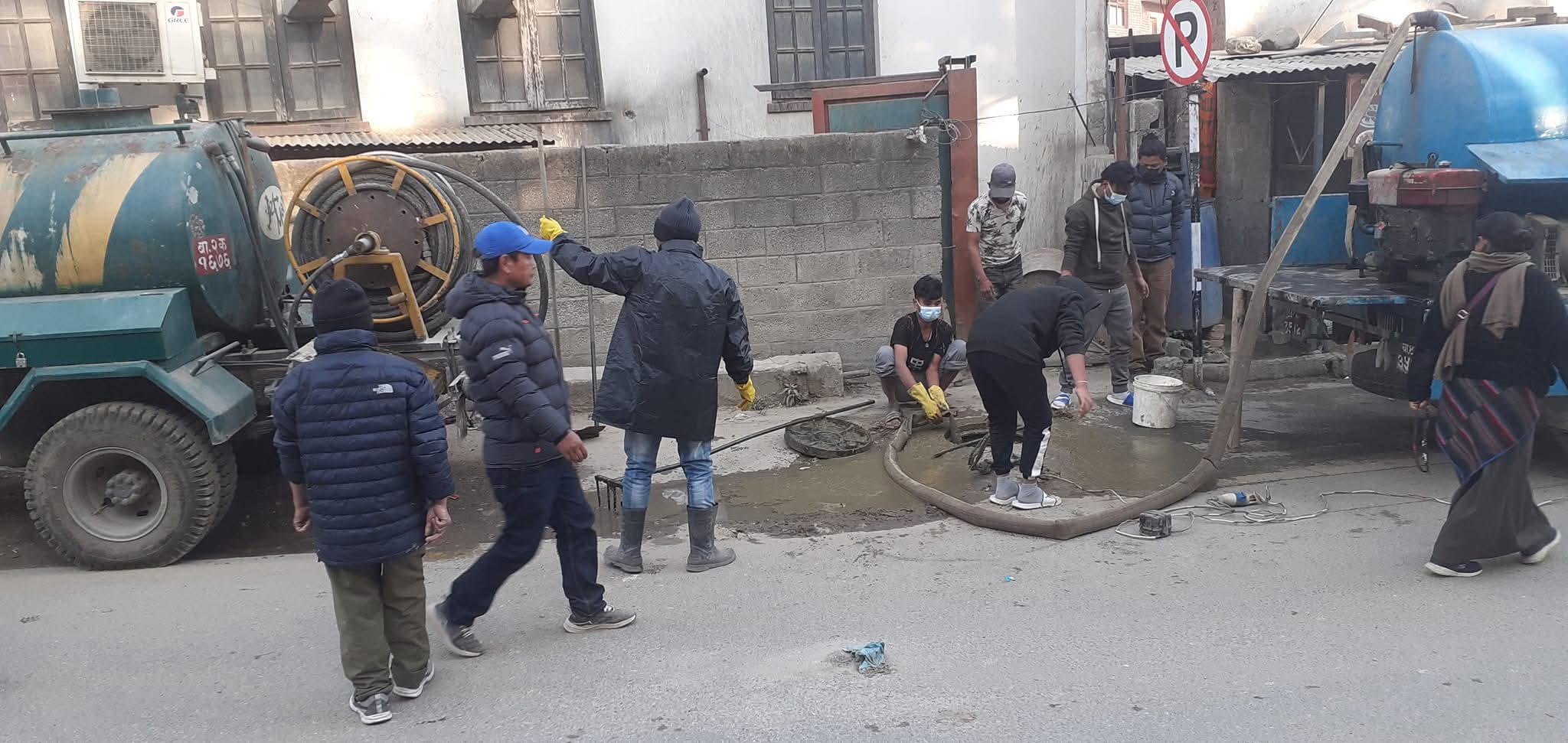
Kathmandu: In the past, when people thought about sanitation work, the image that often came to mind was of workers manually entering septic tanks or sewers to remove waste. They had to squeeze into narrow tanks, face the danger of toxic gases, and work without adequate safety equipment, which forced sanitation workers to operate under constant risk. For a long time, society viewed this work not as a respected profession but rather as a compulsion or a form of low-status labor.
However, in recent years, the entry of technology into the sanitation sector has gradually transformed this profession into a more organized, safer, and professional field. The development of various tools and machines used in sanitation management has brought significant changes. Different types of equipment used to remove fecal sludge from septic tanks or pits have largely reduced the need for workers to physically enter the tanks.

In addition, technologies such as vacuum tankers, motorized pumps, and pipe systems have made the process of waste extraction and transportation faster and safer. The use of these technologies has not only reduced health risks for sanitation workers but has also increased the efficiency of the work.
At the same time, the use of protective gear in the sanitation sector is also expanding. Masks, gloves, gumboots, helmets, protective clothing, and other personal protective equipment are helping sanitation workers protect themselves from infections, accidents, and various health risks. Workers who were once forced to perform dangerous tasks in ordinary clothing are now gradually working with proper safety equipment, making the profession not only safer but also more dignified.
Man Bahadur Pode of Teku, Kathmandu, says, “We have been continuing this work as a traditional family occupation for generations, but now people from other communities are also becoming interested. It is gradually being modernized rather than remaining purely traditional, and it is becoming more professional and commercial.”
According to him, the use of technology has encouraged the development of a professional mindset in sanitation services. Today, many municipalities and private service providers have started operating sanitation services as a structured service system. Activities such as cleaning septic tanks, transporting waste, delivering it to treatment facilities, and managing it safely are now being carried out in a more systematic manner. The practice of setting fixed service charges, providing services on time according to demand, and developing service registration systems is expanding, making sanitation services increasingly professional and organized.

Capacity development of sanitation workers has also become an important aspect of this professionalization. Various government and non-government organizations are now providing training to sanitation workers on equipment operation, health and safety, risk management, and service entrepreneurship. Such training helps them develop not just as laborers but as skilled service providers. Training and skills have increased their confidence and strengthened their sense of dignity toward their profession.
With the professional development of sanitation services, institutional structures are also expanding. In some places, cooperatives, private companies, and service groups have been formed to operate sanitation services. This has made it easier for service providers to work in an organized manner, invest in equipment, and expand the scope of services. Collaboration with local governments, along with policy development and regulatory systems, is also helping make sanitation services more sustainable and effective.
Along with these changes, the interest of young people in the sanitation sector is also gradually increasing. A profession that was once socially stigmatized or considered humiliating is now developing into a business with income-generating potential, says Man Bahadur Pode.
“I used to carry out sanitation work using traditional methods in the past. Now I have gradually modernized it with time. I have even registered a company and am providing sanitation services,” he says.
He currently operates a company called Team Work Drain Clean Service. According to him, a structured service system, reliable income, and the use of technology are creating new employment opportunities in this sector.
Overall, the use of technology, safety measures, skill development, and institutional management are gradually transforming the sanitation sector from a risky and unorganized occupation into a safer, more dignified, and professional profession.
If further expansion of technology, regular training, supportive policies, and a culture of social respect can be strengthened in this sector, sanitation services will certainly become even more effective, safer, and sustainable.