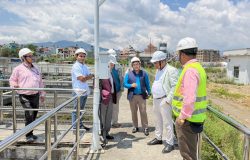
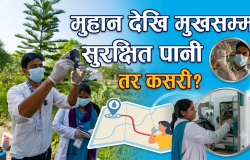
Kathmandu: The main purpose of sanitation workers wearing Personal Protective Equipment (PPE) is to protect themselves from health risks and accidents that may occur during their work. When working with sewers, septic tanks, waste, or fecal sludge, sanitation workers face various risks from bacteria, t...
English
-
-
Technology Transforming Sanitation Work into a Safer and Professional Service
Kathmandu: In the past, when people thought about sanitation work, the image that often came to mind was of workers manually entering septic tanks or sewers to remove waste. They had to squeeze into narrow tanks, face the danger of toxic gases, and work without adequate safety equipment, which forced sanitation worke...
-
Thaiba–Badegaun Shows How Communities Can Sustain Sewer Management
Lalitpur: In Ward No. 14 of Godawari Municipality, there is a unique practice that offers a different perspective on sanitation management in Nepal. We often hear about drinking water and sanitation user committees, but here a separate user committee has been established specifically for sewerage management. The T...
-
Accident Insurance: A Lifeline for Sanitation Workers
Kathmandu: Sanitation workers who enter septic tanks to remove fecal sludge are among the most high-risk workers in our society. Every day, they risk their lives to keep our homes, institutions, and cities clean and safe. However, the irony is that while their labor is valued and paid for, the assurance of their saf...
-
Sanitation Services Must Be Treated as Public Services
Although Nepal has recognized water and sanitation as fundamental human rights, sanitation has still not received adequate priority in practice. Compared to sectors such as roads, electricity, health, and education, sanitation has not been advanced with the same seriousness as a public service. Yet sanitation is dir...
-
Urban Dabali Explores Plastic Circular Economy Pathways for Sustainable Cities
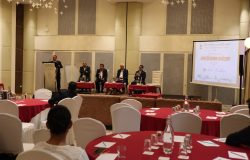
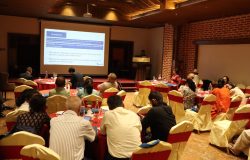
Kathmandu : The Centre for Urban and Infrastructure Development (CIUD) organized an Urban Dabali Talk on “Plastic Circular Economy for Sustainable Cities” on Friday, bringing together municipal officials, waste management practitioners, academics, civil society representatives, and students to explore practical solut...
-
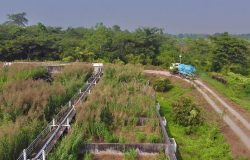
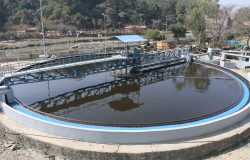
Nature Based Wastewater Management: A Sustainable Solution
Sewerage management has become one of the most serious environmental challenges facing today’s cities and human settlements. With rapid population growth, unplanned urbanization, and changes in lifestyle, the volume of wastewater generated on a daily basis is increasing at an alarming rate. In such a context, wastew...
-
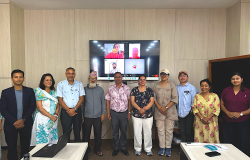
Expert Inclusive Task Force Formed to Implement Fecal Sludge Management Act
Kathmandu: Mechinagar Municipality of Jhapa has decided to effectively implement the Fecal Sludge Management Act, 2082. A stakeholders’ meeting on fecal sludge management, chaired by Mayor Gopal Chandra Budhathoki, held extensive discussions on the matter. The meeting decided to form a five member Task Force compri...
-
Sanitation Workers’ Safety: A Matter of Public Health, Dignity, and Social Justice
When the roads around our homes are clean, wastewater is flowing, and garbage is collected on time, behind all of this lies the labor of sanitation workers who begin their work early every morning. This labor is as essential as it is risky. Sanitation workers are exposed daily to solid waste, sewage, chemicals, shar...
-
Neglecting Vent Pipes in Septic Tanks Poses Serious Health and Safety Risks
Kathmandu: Whether at home, school, office, or public toilet, one small yet extremely important structure is often overlooked in septic tanks the vent pipe. Many people assume, “The tank is built, the work is done.” However, this mindset can lead to serious health, safety, and structural problems in the future. As h...
- « Previous Page
- 1
- 2
- 3
- 4
- …
- 55
- Next Page »