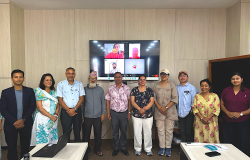
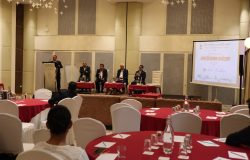
Nagarkot : In a significant step toward ensuring sustainable, equitable, and resilient sanitation services, an introductory training on the City-Wide Inclusive Sanitation (CWIS) approach concluded successfully at the National Water Supply and Sanitation Research, Innovation and Capacity Development Center (NWSSRICDC)...
English
-
-
WaterAid Nepal Stresses Recognition of Sanitation Workers for Sustainable WASH Improvement
Kathmandu: WaterAid Nepal Country Director Sudarshan Neupane has stated that sustainable improvements in the Water, Sanitation and Hygiene (WASH) and public health sectors will not be possible unless the contributions of sanitation workers are properly recognized and valued. Speaking at the public event of the “Sani...
-
Director General Shrestha Stresses Risk Reduction in Sanitation Work
Kathmandu: Director General of the Department of Water Supply and Sewerage Management, Kamal Raj Shrestha, has emphasized the urgent need to reduce the serious health and safety risks faced by sanitation workers engaged in human waste management, particularly in urban areas where rapid population growth, limited land...
-
Men Need to Cry, Speak, and Heal
For generations, South Asian society has conditioned men to believe that strength means silence. From early childhood, boys are told, “Be a man,” “Don’t cry like a girl,” “Crying is for girls.” These sentences are spoken casually at home which are reinforced by culture, and echoed across Nepal, India, Pakistan, Ban...
-
Where Water Flows, Equality Grows: Bridging Gaps Through Inclusive and Resilient WASH Systems in Nepal
Introduction Nepal, often called the water tower of Asia, is blessed with abundant water from Himalayan glaciers and monsoon rains. However, this abundance has some challenges for achieving equality for all Nepalese. As the world celebrates the 34th World Water Day 2026 under the theme “Where Water Flows, Equality G...
-
Why is PPE Mandatory for Sanitation Workers?
Kathmandu: The main purpose of sanitation workers wearing Personal Protective Equipment (PPE) is to protect themselves from health risks and accidents that may occur during their work. When working with sewers, septic tanks, waste, or fecal sludge, sanitation workers face various risks from bacteria, t...
-
Technology Transforming Sanitation Work into a Safer and Professional Service
Kathmandu: In the past, when people thought about sanitation work, the image that often came to mind was of workers manually entering septic tanks or sewers to remove waste. They had to squeeze into narrow tanks, face the danger of toxic gases, and work without adequate safety equipment, which forced sanitation worke...
-
Thaiba–Badegaun Shows How Communities Can Sustain Sewer Management
Lalitpur: In Ward No. 14 of Godawari Municipality, there is a unique practice that offers a different perspective on sanitation management in Nepal. We often hear about drinking water and sanitation user committees, but here a separate user committee has been established specifically for sewerage management. The T...
-
Accident Insurance: A Lifeline for Sanitation Workers
Kathmandu: Sanitation workers who enter septic tanks to remove fecal sludge are among the most high-risk workers in our society. Every day, they risk their lives to keep our homes, institutions, and cities clean and safe. However, the irony is that while their labor is valued and paid for, the assurance of their saf...
-
Sanitation Services Must Be Treated as Public Services
Although Nepal has recognized water and sanitation as fundamental human rights, sanitation has still not received adequate priority in practice. Compared to sectors such as roads, electricity, health, and education, sanitation has not been advanced with the same seriousness as a public service. Yet sanitation is dir...
- « Previous Page
- 1
- 2
- 3
- 4
- …
- 56
- Next Page »